

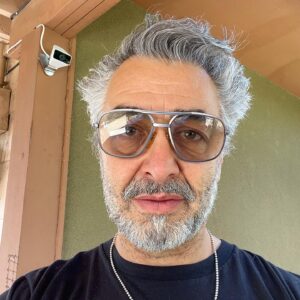
 Freehold faculty Carter Rodriquez has been facilitating the Engaged Theatre Residency workshops at Monroe Correctional Center for years. This past winter, Carter led the men at Monroe in writing and rehearsals that culminated in the production: “El e Mental”—an original live performance exploring the connection between our thoughts and feelings and the elements that we’re made of.
Can we talk about your history of doing residencies here at Freehold?
Before working with Engaged Theatre, I think I studied here at Freehold off and on for four or five years. So I took every class I possibly could, but I hadn’t done any Shakespeare classes yet or training. And Robin [Freehold cofounder and Artistic Partner Robin Lynn Smith] had me audition for The Engaged Theatre program, and it was “The Winter’s Tale.” So I was in “The Winter’s Tale,” and that went to the institutions [as part of] Robin’s vision of reaching extraordinary communities. And of course, we went to Department of Correction institutions—at the women’s prison in Purdy, we went to Echo Glen Children’s Center in Issaquah, and of course, the men’s Correctional Complex in greater Monroe, Washington. That was my very first experience.
Robin was already doing a Residency at the women’s prison, WCCW, and then George Lewis, one of the Freehold founders…he asked me if I would be his intern as he started a new program at the men’s prison in Monroe.
When we originally started, George had this idea that we’re going to do Shakespeare in prison. So that first year, there was something kind of profound that happened, and we went in and we were working with the tent scene from Julius Caesar. We’d read the scene a couple times with some of the guys. And George said, “Could you imagine having to conspire to murder your own friend for the good of the state?” And one of the guys said, ”Well, I don’t know if it’s the same, but one time, me and my friend were drunk and we were playing with a gun and it went off, and I didn’t know if it shot me or shot him. Turns out it shot him.”
We were driving home that night, and George said, “I don’t understand Shakespeare. That guy understands Shakespeare.” And in the next session, there was a participant, an incarcerated gentleman, and he said, “You know, I have stories. We appreciate the Shakespeare, and we always love the shows that you bring in. But what if we told our stories?”
And we changed course immediately that first year, and George started coming over with writing prompts and guided meditations and we devised a piece based on their own writing. We changed course and we realized very quickly that they just needed a lot of permission to tell their stories. And the other thing we realized very early on was everything that you have to train actors to do: given circumstances, raising the states, and understanding the status in the room. It’s built in. You don’t have to do any acting stuff. It’s all built in. They’re already living in a state of heightened awareness based on the given circumstances they are in. Every single day. We don’t have to go to the imaginary places that we work with.
We just have to give them permission. Give them permission, and keep giving them permission. And then they get to hear their own words out loud. They get encouragement from other people. They’re heard. And I really think that a huge part of the reason a lot of these guys are in there, is because nobody’s ever listened to them. Nobody’s ever said, “Hey, you’re doing great.” I know that all of us, by percentage, got a little bit more love than they did, and that’s really the reason that they’re in there, and I’m out here.
The people I’ve worked with, it’s everything you can imagine: [it could be someone from] any gang in Los Angeles or in eastern Washington to businessmen who have two or three college degrees. That entire spectrum is covered with incarcerated people, and they have to cross an enormous amount of cultural boundaries together.
So, you know, a lot of those guys in that program, they have to work with people they would never even talk to. They have to cross all those cultural boundaries. Anything from gender identity to racial identity to anything you can imagine. They have to come together and create a show. We in theater know how difficult that is and what a giant task it is. So we just keep creating a safe space for them.
When we go in, everybody gets a notebook, and we do a little metaphor exercise. So in anywhere from half a dozen to eight or nine sessions, we can generate 200-300 pages of original written material. And I take the notebooks away, and I start looking for themes that are emerging in their metaphor work. And I’ll start sprinkling crumbs on the path towards a theme. And then we’ll take a break. I’ll go away for a month or so, and I’ll cut a script together.
Can you talk about your most recent Residency?
Yeah. Theme wise, there was something about the elements, and there was stuff about mental health that was emerging in their writings [during the generative writing exercises]. And I think that [these ideas] go into your random access brain filters. So people start writing about stuff they’re hearing. Subconsciously or unconsciously…it’s under the surface. And these things start emerging.
So a lot of people are writing about the elements, the physical elements of the world we’re in and the natural world, and [ideas related to] dark matter. And gravity is a metaphor. A bit of quantum physics is emerging. And then there was something about pizza. I don’t know why.
One of the guys had written a piece, and he was talking about the motion of life and how people affect one another. And he was talking about Newton’s cradle pendulum—it came up in his writing. And then we were talking about the natural world and oceans and mountains and then there were a lot of people that were working in Spanish or Spanglish. So one of our lovely participants—he came up with elemental, but it was el e mental. And from emotion to motion.
So he came up with the image of the planet [that’s seen on the program]. I put the art together—thank you very much. But he actually did a sketch the cradle pendulum. We worked pizza in because we needed jokes, so the pizzas became the arrows. And [the piece] really is about the cause and effect of being a human being, dealing with the elements and mental health.
I’m very proud of them. They were just unbelievably creative. And the writing is—and I’ve said this before—but it’s as sophisticated, deep and beautiful as…anything in the history of mankind. It’ll hit you on every level, from your fascination with relationships, to nature, to animals, to how it is to deal with crisis and how we affect those around us. And who doesn’t love pizza? Everybody loves pizza.
Will you be able to share this piece at any point?
I have submitted it to the Department of Corrections. They have to review it. I’m waiting for them to get back to me. I really want to take some of the writing from this piece out into the world. All of the participants signed off on it. I would love to cut it together into something that ends up on the governor’s desk. I just don’t want it to evaporate into the ether like so many shows have.
I’ve been acting for 20 something years. I’ve been in a lot of theater, and…this is the best theater I have ever seen. Not anything to do with my involvement with it. I’m just there to give people permission. I’m telling you, it’s the best in the world. Sorry, I got a little soap boxy.
That’s okay. Thanks Carter.
Thank you.