

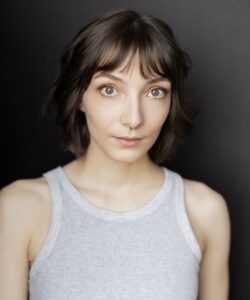
 Lucia Cecchetto is an actor and an alum of Freehold’s Meisner progression, taught by Freehold cofounder and Artistic Partner Robin Lynn Smith. We spoke with Lucia about how she got started acting, what she gained from her acting training at Freehold, and about her own work as an actor and director.
Why don’t we start by talking a little bit about how you came to Freehold. Can you tell us your origin story?
Yeah, so I actually moved here to Washington a couple years ago, right after COVID. I was in Maryland before, and I had done some local theatre and some short films. So I was sort of in the acting world, but it took me a little bit of time to find my like community out here.
And I had actually heard of the Meisner program pretty early on when I moved out. I met some people who were like, “This program is legit. You got to check this out.”
I knew it would be a big commitment, obviously. [Before deciding to take Meisner] I just kept doing short films and tried to stay in the world. And it just got to a point where I really felt like, “Man…I’m following my gut, but I don’t really have a lot of tools at my disposal.”
So yeah, I was really eager [to take Meisner], and I was willing to throw everything else away just to be like, “You know what, now’s the time.”
How did you first get started in theatre?
Oh, it’s hard to trace back origins. I always think back to playing the little acorn on the tree in kindergarten or something. You know, it’s hard to really trace it back, but definitely school productions in middle school, in high school. Doing the plays, doing the musicals, and then I moved here pretty much straight after high school, so it’s been hitting the ground running.
Can you talk a little about a little bit about some of the short films or plays you were doing when you first moved out here?
Yeah, I was lucky to have kind of a community of some friends and people who I knew that were very sort of DIY filmmakers, and that was really helpful for me to be able to see both sides a little bit.
So I stepped into the filmmaking world as well, and I wrote and directed my first short last year. That’s getting into some festivals now, but it was interesting because I really got to see it from the ground up, how to make a film with just one person. And I had done some of the 72-hour film festivals or the 48-hour film festivals.
But it’s been great. I mean, everyone who I’ve met in Washington has been extremely kind, extremely open to collaborating and working and figuring things out together. It has never felt super rigid. Then two years ago, I got with my agent, and that’s when I started to go into a little bit more of the quote unquote “professional space.”
Are there any differences you’ve noticed between the theatre/film culture out there and culture on the east coast?
I mean, for the most part, it definitely just feels bigger out here, or maybe just more noticeable that there are a lot of artists putting themselves out there. There’s so many people reaching out to be like, “I want to work on stuff,” and kind of supporting each other.
I was in the D.C./Virginia area, and then lived in Maryland for a while, where you kind of get engorged by whatever’s happening in New York.
But it’s really cool here because there’s so much happening in Seattle. There’s so much happening in Portland and everywhere in between. You have so many creative people who just want to be in their practice and be doing the work.
What were things with your own acting that you wanted to work on when you signed up for Meisner? What was your thought process about how this class might help you?
I think going into it there was just a lot of self-consciousness within my acting, and being very aware of how I look and how I’m doing, and trying to achieve this idea of a perfect take. I think that’s pretty much how I was operating, and I think I just went into [Meisner] wanting mainly to be in a consistent practice. It’s hard when you don’t have tapes coming in, or you’ve done the thing but now you’ve hit a wall. And yes, you can get together with your friends and maybe go over a scene or something, but [I like] the idea of going into it [thinking]: “I’m going to be acting every week, or I’m going to be acting for five hours tomorrow.”
[Being in the class gave] that sense where I feel like an actor. I think it carried me through the program. I don’t feel like someone who’s trying to take a stab at acting. I’m in it, you know. I’m in it every week, even when I’m not there in class, there’s stuff that I was ruminating on, or taking away, or making notes on. And the work created this foundation of…[being] in it, and I think that’s really what I went into it hoping for.
You can’t really have any expectations, like “I’m gonna get out of this class and I’m gonna book this,” or “I’m gonna join SAG” or whatever. It’s just like, no. “I’m gonna be a part of this collective group of people who are really committing to showing up every week and really showing up.” That was pretty invaluable.
To follow up on that, now that Meisner is done, how do you continue to bring forth that same spirit without the structure of the class?
It’s interesting. I feel in a way that like Meisner hasn’t ended. It feels like it is still a continuation. Like that was just the first stepping stone, and that I’ve just been able to carry that momentum. It doesn’t feel like it’s over. [As an actor] you are constantly going to be learning new things, learning how to be more present for people, learning how to come into a role, having the emotional availability.
I mean, that’s so much of what was instilled in me too, just breaking down some of those ways that we keep ourselves kind of rigid. And that’s never ending. And it’s definitely just seeped into every aspect of my life.
It is obviously different not having the same group of people that you’re showing up with every week [with Meisner being over]. But you kind of get to bring that energy into anything that you are showing up to with other people. I have these ideas about myself or ideas about the work that have me feeling like I’m on a little bit firmer ground going into everything, you know, and mainly just trying to keep that momentum up. I think [the key is] staying true to what that work is, and not falling into self-conscious tendencies. Having the notes and the ways of thinking [that I learned in Meisner] hopefully can carry me through doing any kind of scene work, or an audition, or preparing for a monologue, or whatever it is.
You have experience in both acting on film and stage. Do you think about those things differently?
I think that acting is acting. And it’s funny because I was chatting with one of my other actor friends who was thinking about going into the Meisner program, and I was kind of giving her my rundown. And she was asking, “Is it mostly theatre stuff? Can any of it really be applied [to film]?”
I do think that there are principles, right? In Meisner, you’re not necessarily focusing on the outcome of things like how loud you have to be, or which angle you have to be turned at. I mean, at the core of it, as long as you’re seen and heard [is the important thing]. I think that your principles of how you get to that point—to being in a scene with another person and being in that moment—that applies to both [film and stage] I think.
Immediately coming out of Meisner, I feel like I want to do more theatre because I know the rehearsal process, which is sort of a luxury. Just to be with the same people working through the same thing, not just thinking about it and ruminating, but really acting it out and going for it…that is a new kind of addiction. It’s like, I want to be in these rehearsal rooms more.
You’re someone who acts and directs. I’m curious about how each informs the other?
No, that’s a really good question. And it’s funny because I guess I wasn’t thinking about it too much while taking the program, but the same kind of muscles that you’re exercising [in both acting and directing], they go hand in hand. Like you’re pretty much working out, for lack of a better term, your imagination, your script analysis, but also just how you’re building a character. And I learned a lot, probably the most, from watching other people work and watching my classmates being up there, just witnessing something super raw happening, and sometimes it would put me into that brain of being on the outside.
I would listen to Robin a lot, and kind of what she would say to prompt changes or prompt new ideas, and say “I’m gonna write that down” because that shifted things perfectly. Just being in tune with what’s really going on in your gut, and being in tune with what’s really going on in other people, has definitely been one of those skills that makes you want to imagine more. It makes you want to be in scene work more, and that for me just transcends acting alone.
You mentioned a project you worked on recently. And any others you want to share?
Yeah, that one is called “Still as We Were.” It just premiered at the West Sound Film Fest, and it got into the LA Independent Shorts Fest.
It got nominated for best first-time female director, which was awesome.
Congratulations!
Thank you. Yeah, that was a very kind of nostalgic, sort of sentimental coming of age. Just a short drama that I had in my head that I was lucky enough that I knew some really talented people who could help me kind of pull it off.
But I feel again like in a weird way that I’m really just getting started. You know, there’s so much on the horizon that I’m excited for, and yeah, so much that I want to do, but less necessarily, you know, regarding title and mostly just like man, I want to do good work with good people. You know, yeah.
I had just a couple of months of pre-production from when I got the idea to my friend who’s a cinematographer who was going to be going out of town, and she was like, “Hey, I’m leaving, you know, for Japan all summer or something. Like, do you really want to do this right now, or can we wait? And I was like, just crazed. I’m like, no, we can’t wait. We have to do this right now. And then, yeah, spent about seven or eight months in post production, just editing and coloring and doing all that fun stuff. And hopefully, we’ll be released pretty soon. We’re just waiting for the end of festival rounds now. But yeah, it’ll be out there for the public to see without having to pay for it.
Are there any questions that I haven’t asked you that you wish I had?
I feel like you nailed it. You definitely got a lot out of me. I guess I’ve been thinking about it a little bit.
Some of the biggest takeaways for me are just that Robin specifically feels like one of those once-in-a-lifetime people where it’s like if you’re gonna do anything crazy or if you’re going to go out of your comfort zone, if you’re gonna work on Chekov, or if you’re gonna work on crazy movement stuff, it just feels like she is the best person to do that with. it’s the best environment to fail and then find out how flexible you are, because I think I know for sure for myself, but also for other people, we tend to typecast ourselves a little and just be like, “Well, this is my lane, and I know how to do this.” And it just breaks apart. Like, no, you have so much more flexibility within you that you didn’t even realize. So, all of my kudos just goes to Robin.
Thanks Lucia.
Thank you.
Here’s a short list of some of Lucia’s recent work