

We recently down with Freehold cofounder and Artistic Partner Robin Lynn Smith, as well as Freehold Facilities Coordinator Caleb Pierce, to talk about ongoing facility upgrades at our C/ID studio. Robin and Caleb explain how the new upgrades should make Freehold an attractive, professional, low-cost option for independent producers looking to put on shows in Seattle
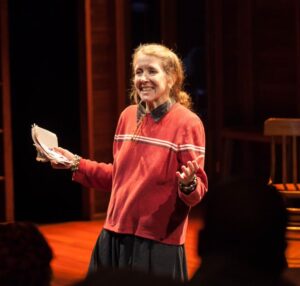 So, Caleb, I talked to you in January of last year about some upgrades in our studio space. I’m wondering if we can get a status report, as far as where we are with those upgrades, and what we have coming up.
Caleb: We’ve gotten new floors in Studios 1 and 2. Previously, those floors couldn’t hold down paint, the paint would peel off in large chunks and flakes, and we would repaint it a lot, [but] the paint would just not stick to the wood for whatever reason. We tried a lot of things. So we finally got to lay down a new layer of MDF, which holds onto the paint a lot better. That’s what we have in our black box. So I think that’s a pretty good upgrade. So that’s the upside.
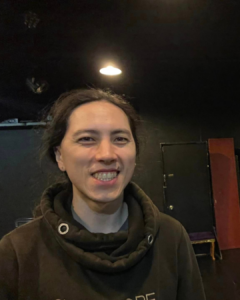 I guess for a while we’ve had an issue with studio lighting being kind of dim, kind of hard to work with. But we’ve done some upgrades around that. We’ve found these awesome light bulbs that go really bright. They’re energy efficient. They have built-in diffusers, so they don’t hurt the eyes so much, even when they’re bright. We installed all of those in each of the studios, and it’s significantly brighter. It actually looks pretty darn great. And we installed dimmers into each studio. So, that kind of is perfect for an acting space because we can dim the lights for more like internal work, meditative stuff, or if we’re just staring at the ceiling for a long time, we can make them bright.
And in the black box, we can split the lights into two sections–so we can light one half of the room at a time, and then dim or turn off the other half. And that’s just with the work lights. We’re not talking about stage lights at all. We’re just talking about work lights.
So I’m really stoked about that. I’ve been here as a student. I also worked here for a while, and the dim lights have kind of been tolerated pain points. So this upgrade is honestly pretty huge. I’m super stoked about it. I’m glad we found those bulbs, and the dimmer function is pretty darn great. So that’s the studio lights.
I’m also pretty excited about the new lighting instruments, the stage lights that we’re in the process of getting. They’re all going to be LEDs, and the reason I’m excited about that is we’ve been working with a limited number of LEDs for the last five years, and they’ve been great. We’ve really needed them, but we’ve only had eight lighting instruments to work with, which is really not enough to light a stage. We’ve had to really get creative with that. So I’m really excited about these new lights. We’ll be able to have a basic rep plot, meaning we’ll be able to light up a stage properly without having to worry too much about it. We’ll have an easy default that we can work with. Anyone can come in, and already have a pretty solid basic setup. Maybe they can get away with making a few minor adjustments, and you can have a show. So I’m super super excited about being able to do that. And I don’t know if we can confirm this, but I believe we’re also going to get a new light board that we expect to have the ability to interface with an iPad.
Robin: It’s going to be state of the art. A lightboard for a small space.
Caleb: Yeah, so that’s pretty cool. Just because one, I think it’ll be a lot easier to use, a lot more straightforward. We’ll be able to store entire shows in the light board without worrying about the floppy disk getting corrupted. It’ll be a lot more programmable, and it will give us the ability to have basic lighting presets that someone who’s not super technical can pretty easily just like hit a button on an iPad and be able to bring up a nice stage lighting setup. So I think that’s exciting for things like speaking events, but even just basic performances.
Just the idea that pretty much anyone can come in with their show and be able to, with whatever creative idea they’re working on, be able to get a pretty decent look without a lot of extensive labor just to set that up—that’s pretty exciting to me. I think that makes us like a pretty darn viable performance and experimental space. So yeah, that’s the lighting and the floors.
Cool. And do we have a time frame for this?
Robin: From your mouth to God’s ears.
Caleb: So the studio lighting is all in place. That’s all been set up. The stage lighting is what we’re working on. We don’t have a timeframe on that.
Robin: You know, the whole vision of this is to create a viable, independent theatre space for production for independent producing companies, right? On a professional level. We’re getting these telescopic seating units, so we’ll be able to seat 80 people in there. It’s completely flexible, as Caleb was saying, so that you can be genuinely experimental in how you want to use the space and how you want to set it up with each given production. It’s not a set ground plan, and it will be flexible to do a lot of different kinds of activities. But we want it to be a resource for the community so that people have a way to produce without having to spend $10,000 on a space, and they can make something really cool happen in our wonderful Chinatown/ID space.
I think the solution of the telescopic seating units, as well as the lighting equipment and the board—that it it is going to be something that people can come in and look at and go “Oh man, I see we could try this, or this, or this, and have a different kind of setup than what is offered in some other spaces.” So I think it’s going to be genuinely a resource for our larger community.
Caleb: I’ll put in a little comment and say I’ve had different really creative people come into this space and immediately see a lot of opportunity here. To be able to actually have the seating units and the stage lights in a sort of easy-to-use format…I could see some pretty amazing stuff happening.
Robin: And I’m going to give a shout out to Caleb. Caleb has created this really cool way that we’re using our already-existing storage space to really stow the things that we need for classes, so that productions have the ability to actually operate in there, and it’s not that hard to make that changeover between things. We have the wonderful Take Five Improv company that has been launching through our space this summer, and they are able to use our space as a really cool, professional-looking theatre space because of the wonderful work that Caleb has done to get the storage worked out.
I know we had some safety upgrades recently. Can you talk about those?
Caleb: Yeah, I hope I can remember everything because we’ve had quite a lot going on. We’ve upgraded the exterior lighting, which is a huge deal because at night, especially during the long, dark, rainy months, having enough light on our front and back entrances is really important. So those upgrades have happened, and I think that makes a huge difference. And then having the cameras [at the front and back entrances] just gives us more of an ability to be aware of our surroundings and what’s going on in the area. So I think that’s all a really big deal.
I’m excited about some of the upgrades that are still in the works, around being able to use a keypad system for letting people in. I think that’ll just save us a lot of time and complicatedness around wrangling keys and letting people in and figuring out lock boxes. I don’t know if this is something that our [students] will directly feel, but I know from the perspective of staff [and faculty], that’s going to be a huge relief. I think it’ll also help renters a lot, to be able to run their shows and have the space feel secure.
Speaking of the space, and renters, I know you’ve been developing rental packages. Anything to report there?
Robin: Yeah, we’re putting together a production package and a sort of contract and addendum for people who want to use the space for production. Caleb and Caroline [Managing Director Caroline Kim] are really central in that, and we are in the middle of going to a second draft on it, so we’re hopeful that that’ll be coming really soon.
Caleb: I know before my time, it seems like Freehold had a pretty robust rental program. That’s my impression, based on some of our old documents. Putting together this rental package will be pretty great. It’s definitely a lot more professional, and it makes it way easier to let people understand upfront what they’re able to get out of it, and have a really clear idea of the setup that Freehold is offering. And I think it’s actually an amazingly good price for someone to be able to do a professional show here. And the rental package is just going to enable us to communicate pretty clearly what we’re able to offer, and that’ll just help a lot with things like planning and setup.
Robin: I completely agree with Caleb. For us as Freehold, but also for the independent producers, they have a very clear map of a process and things that they need to provide and things that we can provide, and it’s all going to be spelled out in a way that there’s no vagueness. So just clarifying a process always makes it more usable for everybody.
If there are people that want to use the space during the day, during the week, we can give them a very good rate. If they have an ongoing thing that they would like to do—if there’s somebody who would like to run something during the daytime on a regular basis, during the week—we have space available, and they could probably get a really good deal. And we have a great location; it’s half a block from the light rail.
Thanks Robin, thanks Caleb.
Robin:Thank you.
Caleb: Thank you.