

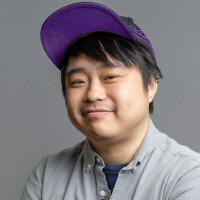
Yichao is a playwright, actor, improviser, and teaching artist. He is also the founder of Take 5 Improv, which completed a residency this summer at Freehold. We spoke to Yichao about what attracts him to improv, what made him decide to found an improv company, and what the future holds for Take 5.
 Can you talk a little bit about how you first got involved in improv?
Yeah, I first started doing improv when I was 18, and I was graduating high school, about to head off to college, and it was my last year to take part in this teen troupe of a local theatre. And so I joined because I had started doing theatre my senior year.
After doing a year in the troupe, I really had a good time. And I was like, “Oh, but now I’m too old. That’s sad.” I just made all these friends.
The coach of the troupe asked if I wanted to be an assistant coach of the troupe. So I participated with the troupe for one more year, in a coaching and leading role. And since then, I took improv classes in undergrad. I performed at a local theatre in Arizona where I did a bunch of different short form shows— very “Whose Line Is It Anyway?” style of shows. The theatre that I performed at had four shows a week: two shows on Friday, 8 and 10 p.m. two shows on Saturday, 8 and 10 p.m. And there would be weekends where I was in all four shows.
I just couldn’t get enough. I was doing all the shows, doing all the rehearsals. So I did that all throughout college, and I went to LA for grad school. I took classes at Second City, took classes at UCB, took classes at all the different theaters that I could find. And since then, I’ve taught improv, [I’ve] directed improv.
When I moved to Seattle, I joined Jet City Improv’s troupe, and I also directed a show there. And I’ve just been doing it nonstop since then.
Can you talk about what specifically about improv really speaks to you and what kept you at it for so long?
Absolutely. One of the things that drew me to theatre and acting was I felt like I was terrible at it, and I couldn’t figure it out. It was hard and it wasn’t solvable in the way that math or programming or other things are solvable. There’s so much mix of activity and it was just this really hard challenge. And I tended to be a very cerebral, in-my-head kind of person. I like to think things through. And improv just really demands of you to be present in the moment and to be reacting to what’s happening in the room. And if you catch yourself planning and thinking “Oh, I think I know what’s going to happen next,” you’re going to miss something magical, right? That happens because it didn’t fit your plan or your expectations. And so I love that challenge. It demands you to be a great listener, and it demands you to be very present, and I kind of love that—the thrill of stepping on stage, not knowing what’s going to happen, and discovering something really magical or moving or funny.
You mentioned acting, do you still act in scripted works?
Yeah, I would say right now improv is the majority of the space I get to play in. I performed in a couple scripted games last year. I did some staged readings and worked with youth theatre last year. But in terms of acting, with my day job, there just has been a little bit less time for it.
Can you talk about how Take 5 came about?
I officially started it this January of 2026, and before that, in my head…I’ve been toying with the idea of opening a theatre for a while.
And for the longest time, at least while I lived here in Seattle, I was like, “Oh, I don’t need to open an improv theatre. There’s a bunch of improv theatres who are really cool. And you know, one of my favorite articles I read shortly after graduating is called “You Want to Open a Theatre? Please don’t,” or something like that. I think it gives really good reasons to not [open a theatre]. [The article asks you to think about] why are you doing it, and what are you trying to serve, and are you actually serving a need, or is your work actually a great contribution to another existing company?
For me [what were my reasons to start Take 5 in 2026]? One was geographical. I had moved to South King County, Renton, and I noticed that Renton really doesn’t have improv or much nightlife and activities and things to do in the area, and so there’s this kind of lag.
And you know, in Seattle there’s a lot of improv going on: Jet City, Unexpected Productions, Bandit Theater, we’re getting a UCB. So there’s a lot happening, and there’s just not a lot happening in my neighborhood. So the first motivation was, “Hey, I can make something here for this audience that currently doesn’t have access to it.”
And the other [reason to start Take 5] was creative. I think a lot of the other improv theatres are currently working on a season model that is kind of like a regular theatre—a scripted theatre, I should say. So they do shows on a three-week run that rehearses, and then does the three-week run.
And these shows tend to be themed, and specifically, a lot of these shows tend to be themed around a parody of or riff on popular culture or other mediums. And to be clear, I love these shows. I’ve auditioned for them. I’ve directed one of them. They’re a lot of fun to be in. So these are shows like an improv take on a Severance-style show, or an improv take on Game of Thrones, or an improv take on White Lotus. They’re really cool shows.
Jet City used to have a show that was just a weekly show that was just improv, and that kind of has fallen by the wayside.
And so those are two factors: there’s not a lot of improv in my area, and there’s not a lot of this particular style right now.
And hearing from performers that I knew who are phenomenally talented and hungry for performance opportunities also motivated me to create the company. We started with monthly shows at venues like Lucas Table. We performed at Renton Civic Theater, and then we got to work with you guys.
Can you talk a little bit about the format of doing longer-form improv? This is something I was less familiar with as an audience member, having grown up on “Whose Line Is It Anyway?”-style short-form improv.
Yeah, so in the first shows we performed at Aztec Live, we actually had a two-act structure that I shamelessly lifted from a theater called Furious Comedy in Portland. They’re an improv theatre that does a wonderful show called the Comedy Showdown, and in the first half of their show, it’s “Whose Line is it?” It’s short-form games, and after each scene or each game, the audience will judge us on a scale of one to five, and the performers in those scenes will get points. And then in the second half, they have [improvised] movies that directors direct. And so basically, out of the five performers in Act One, the three top point-getters become directors, and they direct the movie for Act Two.
So we started with that format, where we started with short-form games, and then we got to the movies. And it was really interesting because across the first two audiences, people liked the short form games…but they thought the movie thing we do is really [freaking] cool. And so it kind of flipped my assumptions [because people generally are more familiar with short-form improv].
And I think, frankly, the performers that I had in my group are stronger on the more scene-based, acting-based improv than the short-form, games-based, sketch-based improv. And so for me, I thought, “Oh, the audience was more interested in longer-form improv, and I know this is the part that the actors tend to enjoy more as well.” It seemed like a perfect opportunity to expand it into a whole format for that show.
And the improvised musical is just a musical. We keep it pretty simple and really encourage people to be playful and silly about music. It’s kind of how we got to those two formats.
Can you talk a bit about how you kind of came across Freehold and how this collaboration started?
Yeah. So I was initially introduced because Freehold was seeking additional board members, and my friend Brandan Minaya [encouraged me to join the board]. I told him “I don’t know if I have time for board membership, but I’d love to meet them as a venue and as an organization.” When I met Robin [Freehold co-founder and Artistic Partner Robin Lynn Smith], I think immediately I was really struck and inspired by the work and mission.
Also, just learning how many folks have come through your doors and how many [Freehold alumni] that I’ve seen on stage. It’s cool. And just the quality of classes being offered and the focus on accessibility—it was all super inspiring for me. And so I was really excited to get to know Freehold more.
And so, from my conversation with Robin, I wrote up a proposed memorandum of understanding of how [a partnership] might work. And so it really was just very aligned with the stars, [as far as] the things we were looking for.
It’s been a really good experience. On my side as a producer, it’s really thrilling that the actors get the stage time that they’re looking for. We work really hard to schedule folks so that they can get a lot of stage time, but also not feel like they have to be there every week. So there’s a really good balance on that.
The space has been the perfect kind of size and shape. We’re really small, so getting started in an intimate setting [is ideal]. And we have the basics of lights and a little bit of audio— just the right amount of tech support without it being overly complicated. So all that has felt like a really good fit.
My last question is: what do you see as next both for you as an individual, and then for Take Five?
Yeah, I think with Take Five, our agreement with you guys is through the end of the summer, so we’re excited to continue performing. Medium to long term, I am still talking to different venues [about finding a permanent home] with some promising leads.
We have also applied for a pretty big 4 Culture grant, so we will find out in October if we get that grant. If we get that grant, that makes it a lot more financially responsible and feasible to sign a lease. It’s just kind of play by ear. With a lot of it, like improv, I’ve learned [it’s good to] have some ideas that you want to try out, and then really just respond in the moment. But I’m really excited in terms of, I think our show is in a really good place and we have a really great cast, and so [we will] keep performing. And then depending on how various financial things shake out, we’ll either go into our own physical space next year or look for other partners or other opportunities.
Thanks Yichao.
Thank you.