

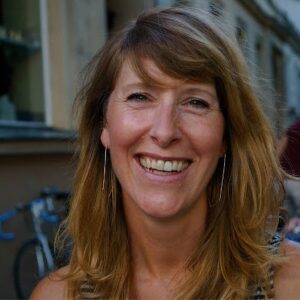
 Jessica Jobaris is a Seattle-based dancer, choreographer, and actor who has been involved with Freehold since the 2000s. We sat down with Jessica to talk about her peripatetic existence that led her away from and back to Seattle, the similarities and differences in choreographing for dancers versus actors, and what has challenged her and surprised her about her work on Freehold’s ambitious upcoming play, hidden/current, a play written by and featuring an international cohort of artists that investigates gender-based violence across cultures.
So before we talk about the project, can you just tell me a little bit about yourself and about your artistic journey.
I think I’ve always known that I wanted to dance and move. My mother saw that in me, so she threw me in classes when I was like four and couldn’t sit still. Then I just fell in love with dance, and I kept dancing. I came from a kind of a rough childhood, and so dance was very therapeutic for me. It was a safe place to put all my emotions.
So then I went straight into college—Cornish College of the Arts. And that is where I really said, “Yes, I’m a dancer and I’m going to dance, but I really want to make work too.” So I graduated with a BFA, but I really did an emphasis on my own choreography. I mean, it’s part of the program too, but I just felt that that was really something that was calling me. And then from Cornish, I stayed in Seattle for, I think, six years. I danced with different companies, the Maureen Whiting company, Mary Sheldon Scott, and Jarrad Powell…amazing choreographers. And then I tried my hat in New York City, but I arrived right after 9/11 so I just didn’t have the best welcome. No auditions were happening, and I realized I didn’t want to work, you know, 60 hours in a restaurant, so I came back here. I was here for another eight years. Danced for more great companies, and then I took off to Berlin, Germany, and studied in Italy…and came back to Seattle, because it just keeps pulling me back. Every time I move away, I get pulled back. I’ve been here now for the last 15 years. I’ve worked with Robin [Freehold Artistic Partner Robin Lynn Smith], doing the Engaged Theatre tours with taking Shakespeare into incarcerated populations, on and off since, I think, 2007. So we’ve worked on several projects together. And then when she asked me to do this, I was just completely honored.
What are some of the ways that working with actors is different from working with people trained in dance?
The first thing that comes to mind (and this is changing in the dance culture and dance world) is: dancers say “yes.” Dancers mimic dancers. It’s not that we don’t have a voice of our own, but at least how I grew up, it’s like, “Here’s the movement. You repeat it until it’s perfected.”
Working with actors, there’s a lot more collaboration, there’s a lot more input from the actors. And I love that. There’s also differences in translation on the body. You know, I can come in and be like, “Okay, dancers, we’re going to do 5, 6, 7, 8.” And with actors, it’s more like 5, 6, 7…okay, 8 is not working for whatever reason, whether it’s injuries, it could be they think “What about this idea?” There’s more malleability and more translation, more stimulation of creative ideas when you’re collaborating. So even in my own choreographies, I’m always working with a good mix of actors and dancers, because I love that kind of collaboration and the sharing. I love seeing actors really find their movement—their own movement—within the choreography, because it gives it so much more richness than just, like, “I hit my marks, I hit my lines.” And I love when the dancers can find more nuance and expression and even use their voice or text in ways that carry the story along. So there’s like a symbiosis, but then they each have their own challenges.
I know that this project has been in production for at least a couple years. Can you talk about how you became a part of it?
That’s such a good question, because [Robin and I] had several meetings. Robin and I like to brainstorm, just brainstorm, and just talk about the ideas and talk about the images and the symbolism. And she’ll come in with [something] and it clicks and inspires something different in me. And so there’s often just a lot of conversation.
And I think it might have been at the end of last summer that she checked in about it. So we started meeting in the fall, I think. Then I read the first draft— [it was] maybe the third for them, but my first draft of the script. And then we started with the performers. There’s been a lot of work done, but it’s spread out, and we meet quite sporadically. So I think by the time that I’m leaving for Cape Town, it will have easily been a year. And we’re still working. We’re working a lot. September and October are going to be some bigger months of more rehearsals and kind of beefing it up, because they leave in October.
Can you talk about what attracted you to the project?
A lot interested me. I always feel so wonderfully challenged when I work with Robin, because, again, I have to hone my skills, my translation of movement collaboration, and then Robin comes in with her vision too. So it’s like a trifecta between the artist, myself, and the director. Working with Robin is seriously a really high honor to me. It always has been, and I love learning from her and how her eye works.
But then there was the play itself, and just the idea, the theme of violence against women. And I told you, I grew up in a difficult childhood, and so that’s part of my story. And I have always thought that dance would lead me towards working with women who have survived those stories. So, you know, here I am, many years later, and I’m getting an opportunity to do this in a sort of way that honors my ancestors, you know. So that was another big hit. And then, of course, just the ability to experience other cultures through the eyes of these playwrights and to go to these places, and to be steeped in another culture and to learn about this specific subject from their eyes. So it’s kind of multi-fold reasons and inspirations, really.
This is obviously a really ambitious project, working with people from different countries and traveling. Are there specific artistic challenges or opportunities that you think about in working with people who are not American, who have different cultural backgrounds?
Absolutely, yeah. And, yeah, I was even talking about that with Robin. She was mentioning how important their language is to them and how you say their names, and that’s going to be a challenge for me. I’ve never spoken the language that we’ll be working with, and so you have to make different sounds with your mouth in some ways. And, you know, I don’t like being called Jennifer. My name is Jessica, right? So I don’t want to call someone the wrong name over there. And even today, I was wondering, like, do I need to dress a certain way? I’ve been in different cultural environments where women can’t show their shoulders or above their knees. So, you know, there’s some things that I’m just curious about, and I think that all that’s going to be clarified. But, yeah, I think cultural differences are just going to be bound to happen. And I just am tasked with doing some serious research on my own too, so I can represent Americans with the right intent.
Do you think about the choreography itself differently? Do you approach that part differently given you’re working with international actors and performing for international audiences? Or is that language universal?
I think yes and no. I mean, there’s been such a hierarchy of European dance that has been a majority of my training, and so I think when working with dancers from other cultures, it’s like, let’s explore how your culture can inform the choreography so that it is culturally sensitive, culturally integrative to the process artistically and the project as a whole. Robin and I have already been discussing how to add in some Persian [style of movement]. They’re very ornate and expressive through the hands. And maybe some more rhythmic work for representing more of the African culture. So yes, letting the work be informed by other cultures is, I think, going to be imperative for the project to succeed and feel like it’s bringing everyone together in their differences towards that shared humanity.
Is there anything else that excites you about the project, or anything else you’d like to mention?
Yeah. You know what’s fascinating, Dan, is that one of the angles that Robin has really illuminated for all of us is that, yes, in the choreography, and in the text of the play, there’s a lot about what is happening to the women, but we’re also kind of flipping the perspective a bit to also ask: how does violence against women affect men, and how does it change them? So that is something that I think is, surprisingly, really important. [Violence] doesn’t just affect us women. It affects the men too, and the perpetuation of it really doesn’t serve anyone in the end.
So, that’s an angle that Robin has really illuminated for all of us. And to engage with that in the choreography has been an awesome challenge.